Collection 01 · Living rooms
Warm Minimalist Living Room Ideas: 10 AI-Designed Concepts
A material-led study of cream boucle, pale oak, limewash, terracotta, linen, and softly directed light.
Warm minimalism makes a living room feel composed without making it feel empty. It keeps the clear lines and visual restraint associated with minimal interiors, then softens them through tactile fabrics, natural timber, chalky walls, and light that changes gently through the day.
The ten spaces shown here are AI-designed concept visualizations intended as styling references rather than photographs of real homes.
What I find most convincing across the collection is how often a room needs only one strong material contrast to feel complete: boucle against oak, terracotta against oatmeal linen, or a dark evening window beside a warm lamp. The quieter images also make a useful point—negative space becomes inviting when its surfaces have texture and its lighting has direction.
Soft, Open Living Room Layouts
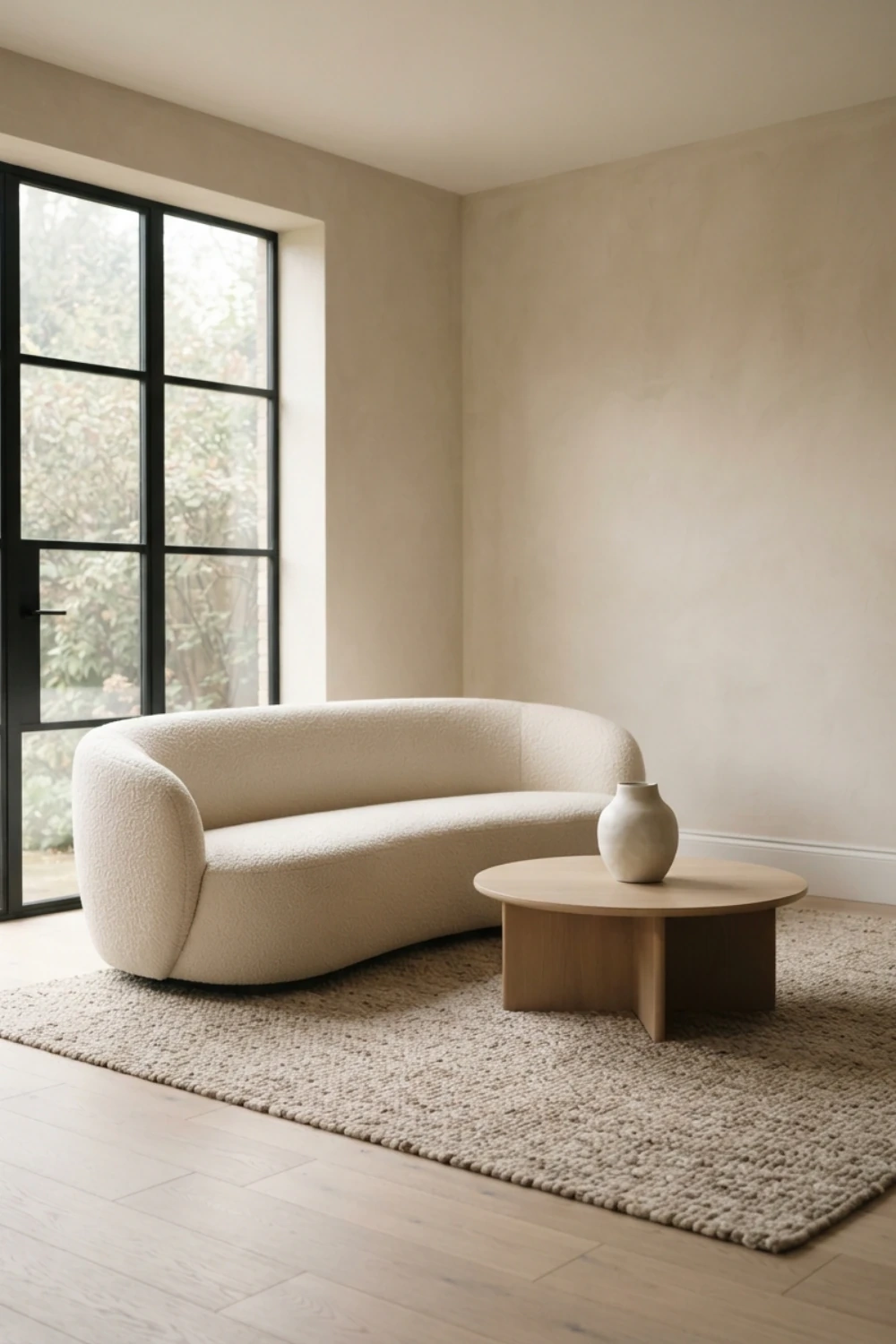
The first concept establishes the collection’s central palette with a curved cream boucle sofa, a round light-oak table, and a softly textured beige wall. A black-framed window on the left gives the pale room necessary definition, while the broad neutral rug anchors the furniture without introducing another color. For a similar scheme, use warm off-white across roughly 60 percent of the room, pale timber and oatmeal textiles across 30 percent, and reserve the final 10 percent for dark window frames or a single ceramic object.
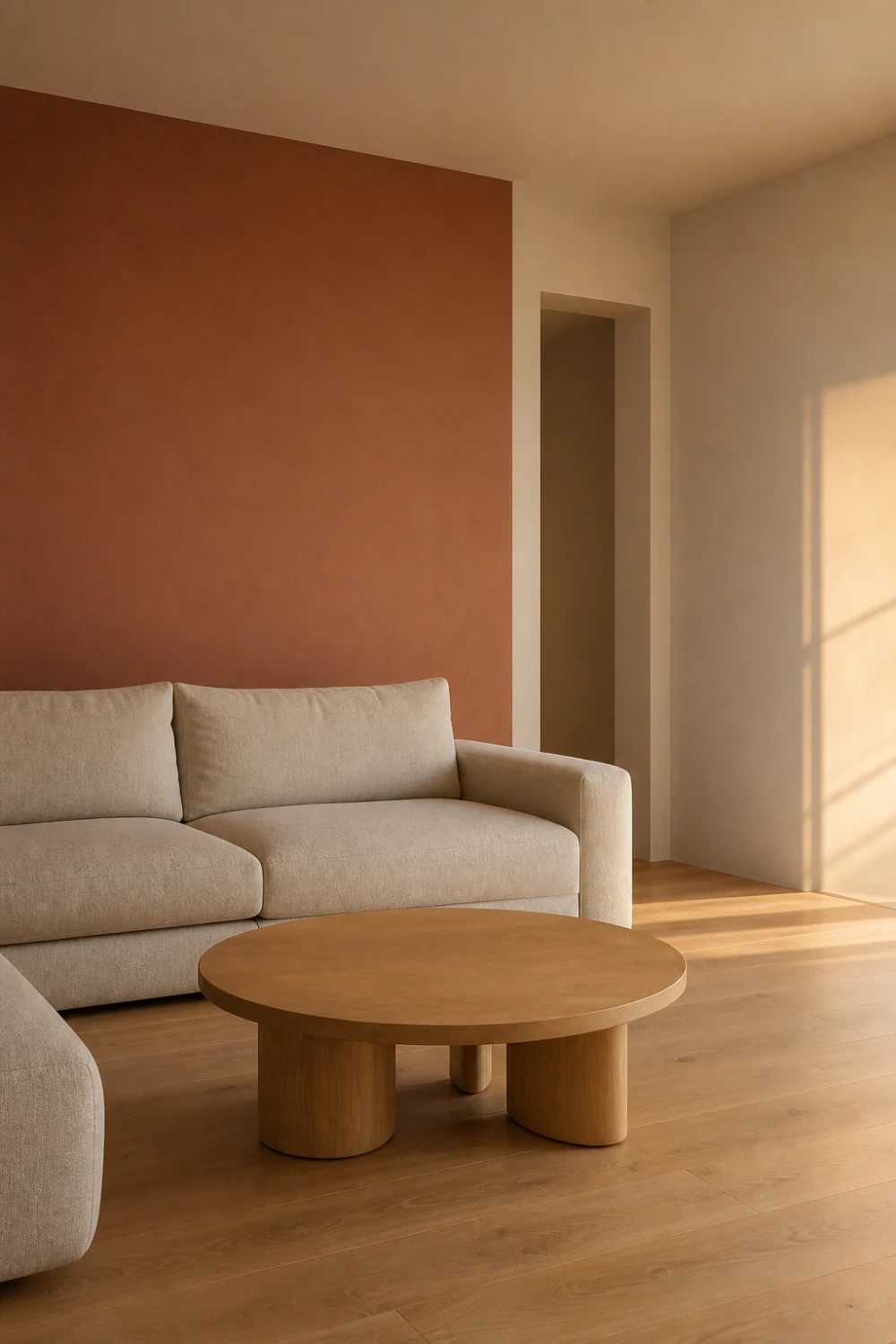
Terracotta changes the same restrained vocabulary without making it feel busier. Here, one muted clay wall sits behind an oatmeal sofa and round oak table, while the remaining walls and floor stay pale. The golden-hour window shape is more defined than the diffuse light elsewhere in the collection, but it works as a temporary accent rather than permanent decoration. If using terracotta at home, keep it to one architectural plane and choose a browned, mineral shade instead of saturated orange.
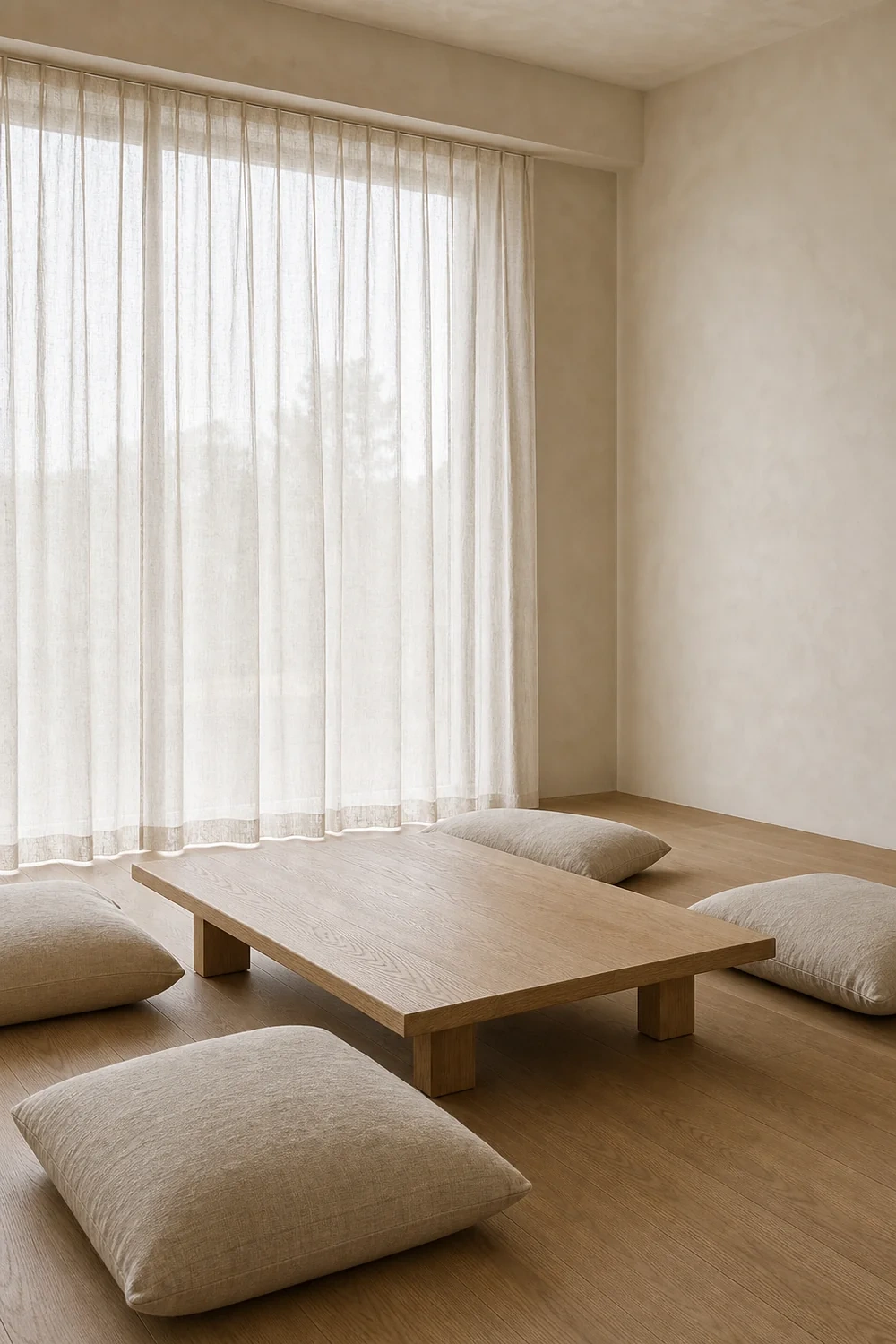
The third room lowers the furniture rather than adding more of it. Floor cushions sit around a very low oak table beneath full-height sheer linen curtains, creating a calm arrangement suited to reading, tea, or informal conversation. The vertical composition emphasizes the height of the curtain and the generous space above the table. Low seating works best when the surrounding architecture stays simple and the textile weights are substantial enough to look intentional.
Curved Seating and Quiet Corners
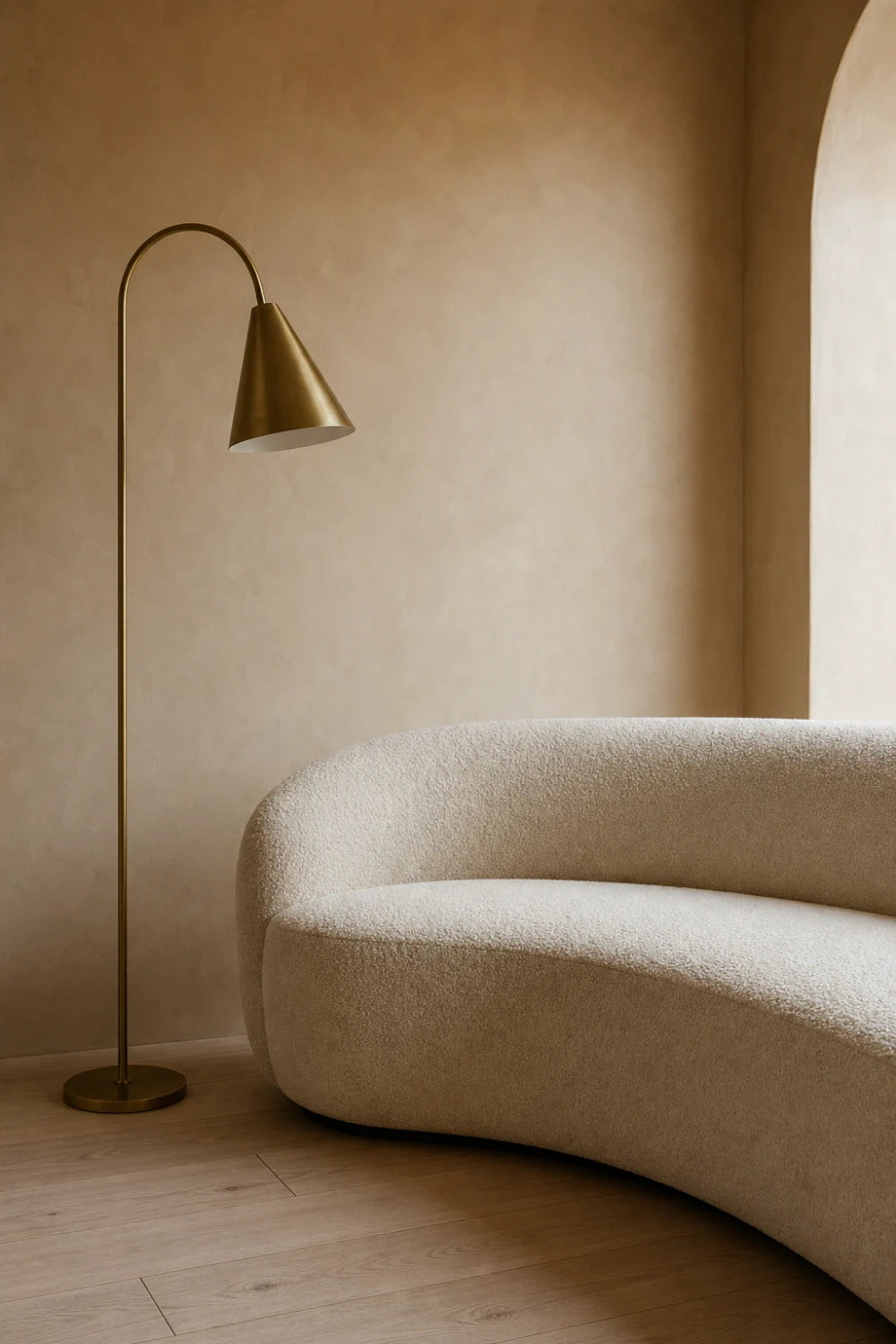
A medium view makes the relationship between silhouette and light easier to study. In this concept, a curved cream sofa occupies the lower half of the frame, balanced by a slender raw-brass floor lamp that remains switched off. The lamp contributes a vertical line and a muted metallic note without competing with the daylight entering from the right. Choose one aged or unlacquered metal finish, repeat it no more than two or three times, and let it sit against plaster or timber rather than polished stone.
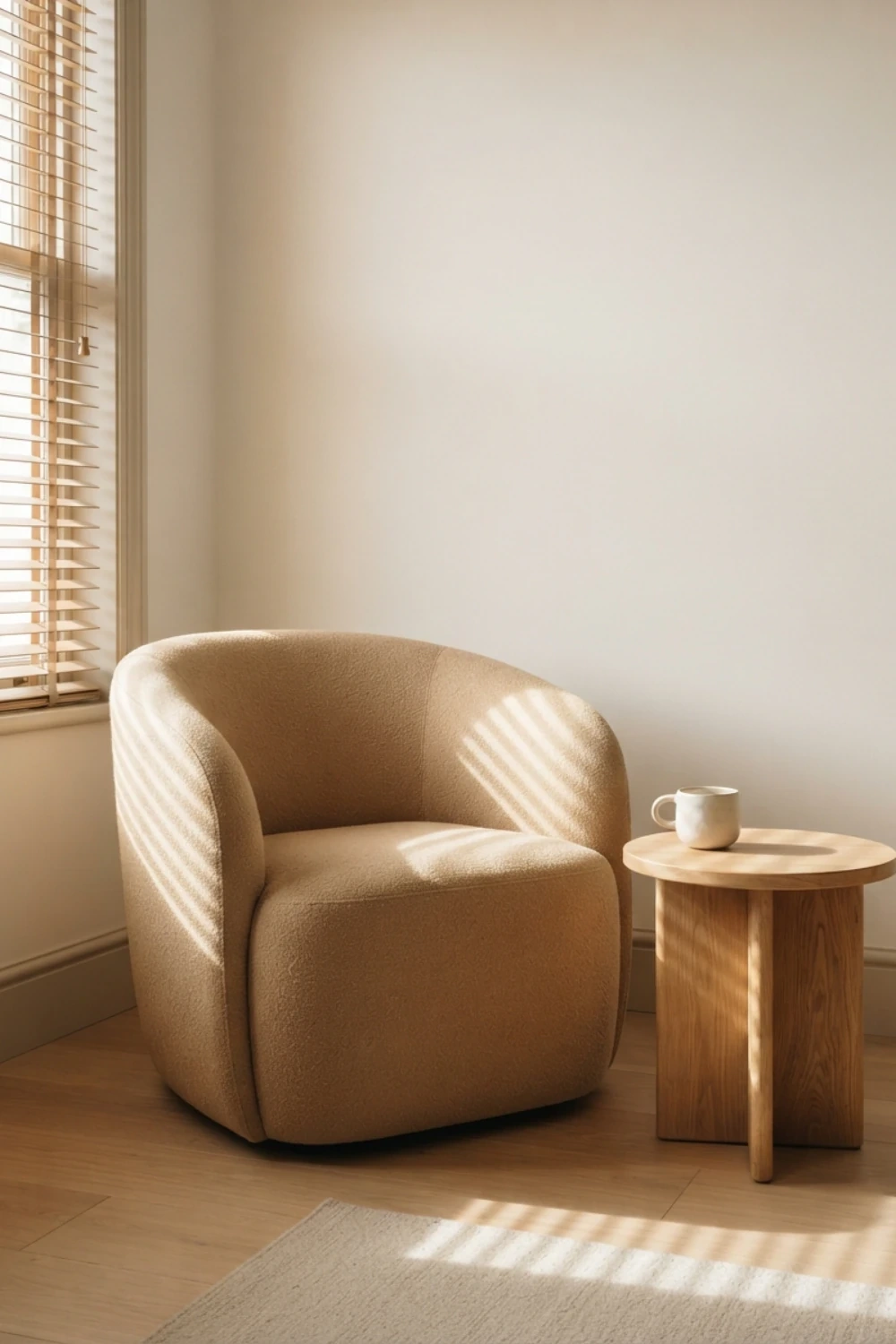
The reading corner is more compact but follows the same logic. A sand-colored armchair and small cylindrical oak table occupy the lower part of the room, leaving a broad area of blank wall above them. A single ceramic cup supplies the only styling detail. Striped light from the blinds crosses the chair, table, floor, and edge of the rug, giving the corner movement without adding objects. Size the table to the chair rather than the room: it should be easy to reach and low enough not to interrupt the chair’s curved profile.
Texture at Close Range
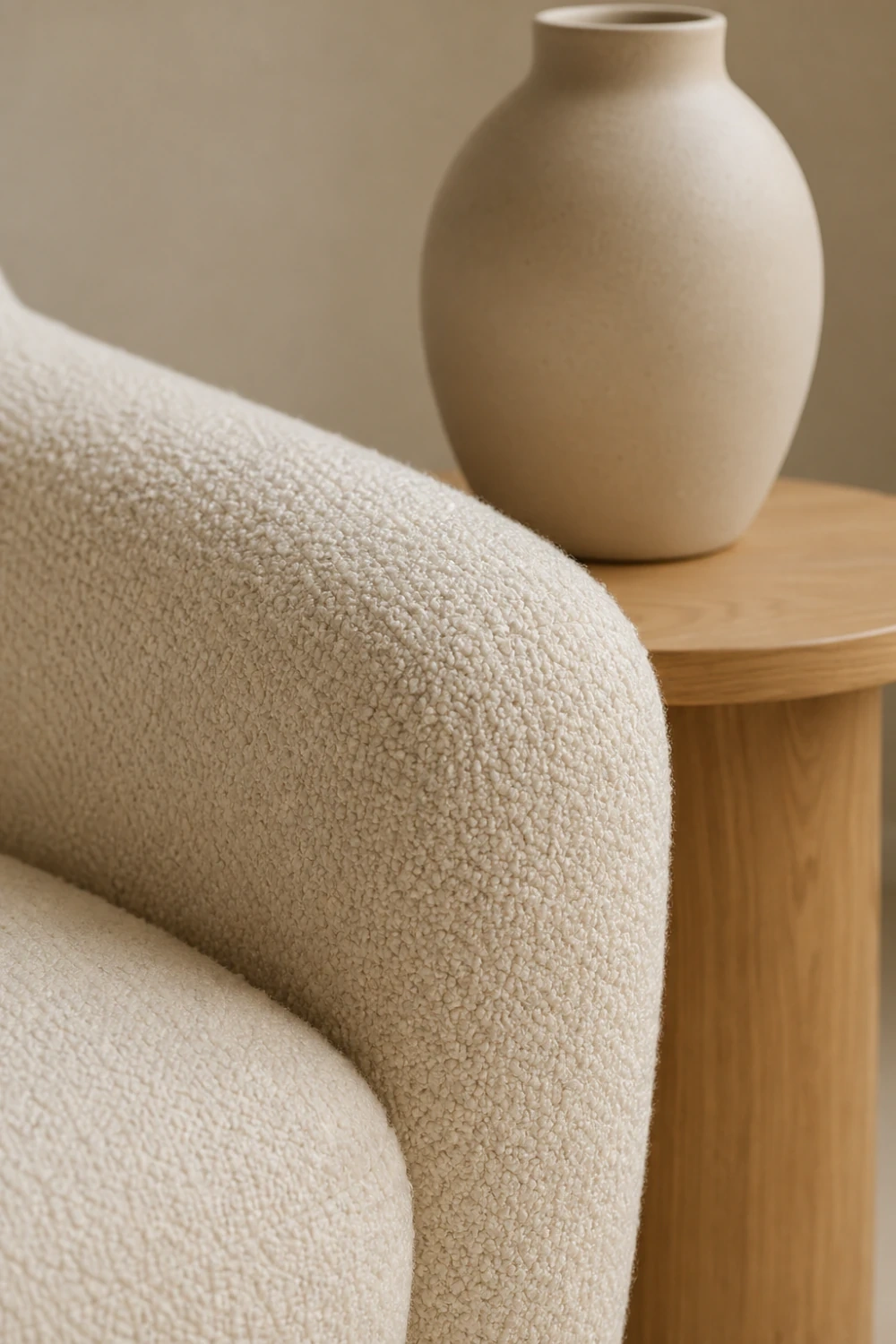
Warm minimalism depends heavily on surfaces, so close views are useful rather than merely decorative. The boucle sofa detail shows irregular loops catching soft window light, with a matte ceramic vase and light-oak table set just behind it. None of the materials is glossy, yet the scene still has depth because each surface reflects light differently. Pairing works best when textures vary but undertones remain related. Cream boucle, pale oak, and warm white ceramic all sit within the same color family, allowing the fabric loop, wood grain, and fine ceramic speckle to provide the contrast.
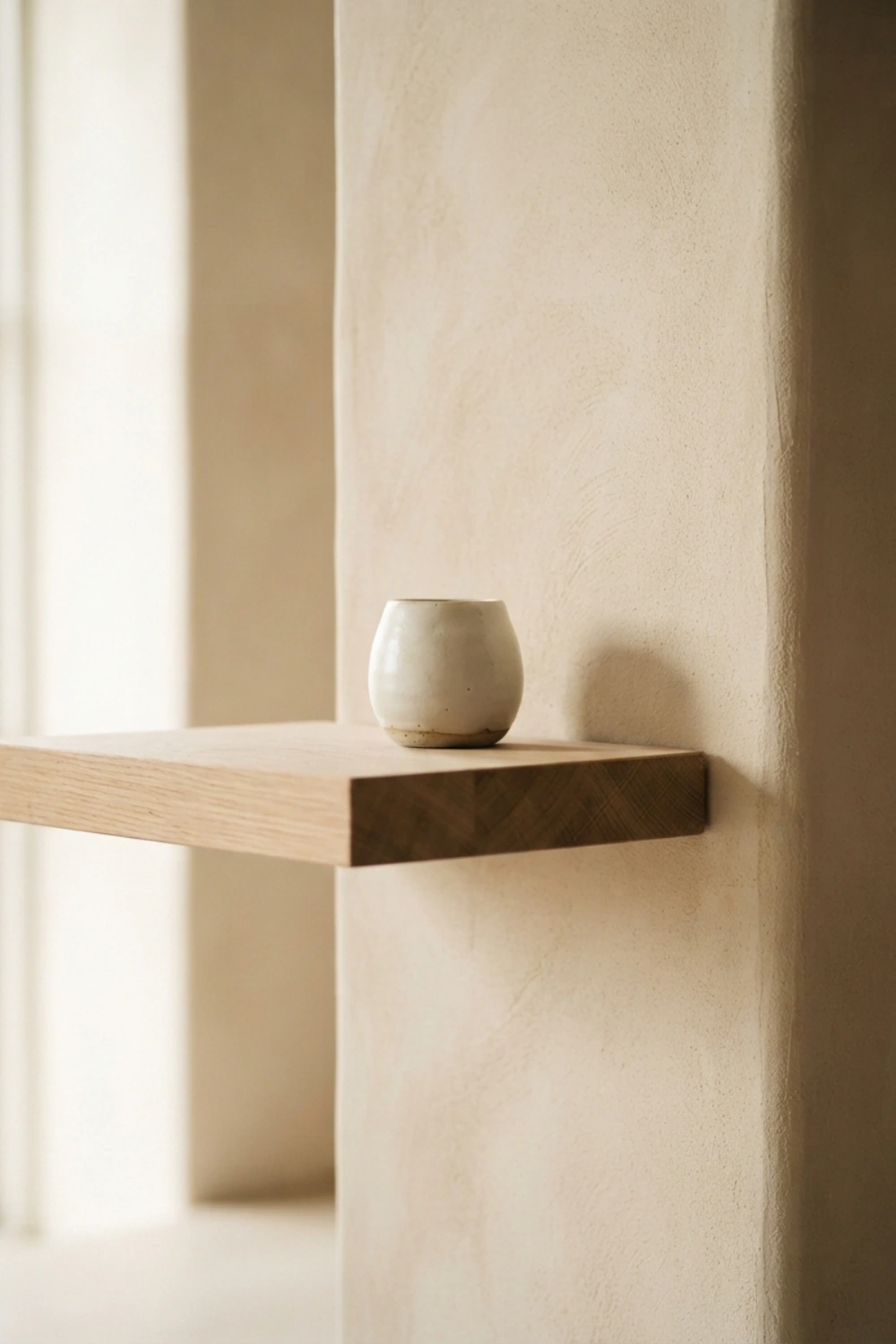
The floating shelf offers an even simpler material study. One thick oak board projects from a fine plaster wall and holds a single rounded ceramic object. Soft daylight from the left creates a shadow gradient across the wall, making the plaster’s slight irregularity visible. This kind of shelf should be treated as an architectural line, not as open storage. Keep its fixings concealed, choose a board deep enough to cast a useful shadow, and leave most of the surface empty. One object with a shape that contrasts the shelf’s straight edge is enough.
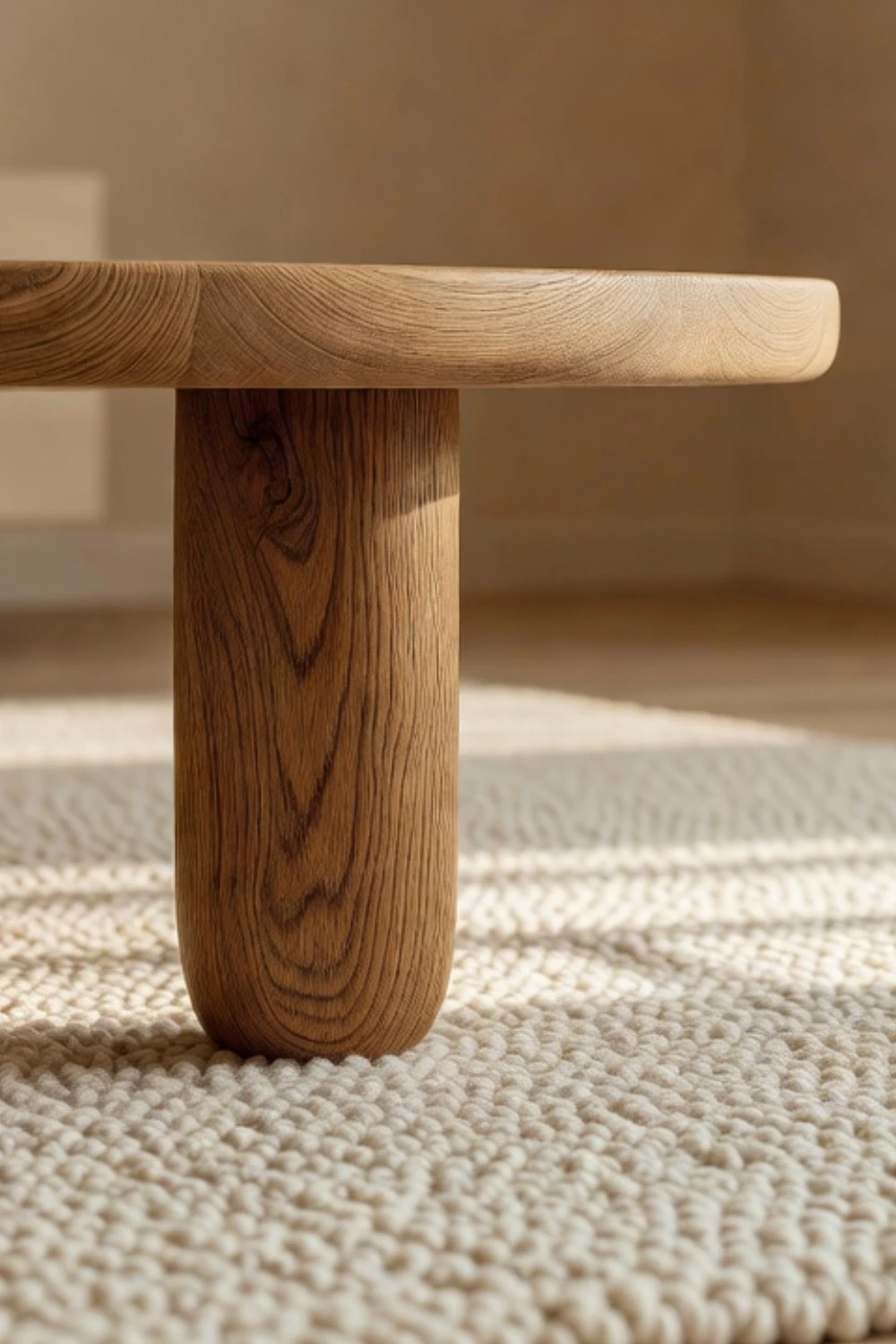
At floor level, the rounded leg of a solid-oak coffee table meets a thick undyed wool rug. The close crop shows why these two materials are a reliable pairing: the timber grain gives directional movement, while the wool supplies a dense, irregular field beneath it. A rug for this style should feel substantial but not patterned. Look for looped or lightly nubby wool in an oatmeal tone, then allow the table edge and legs to provide the geometry. Keeping both materials close in value also makes the transition quieter and lets afternoon shadow define the form.
Framed Views and Evening Light
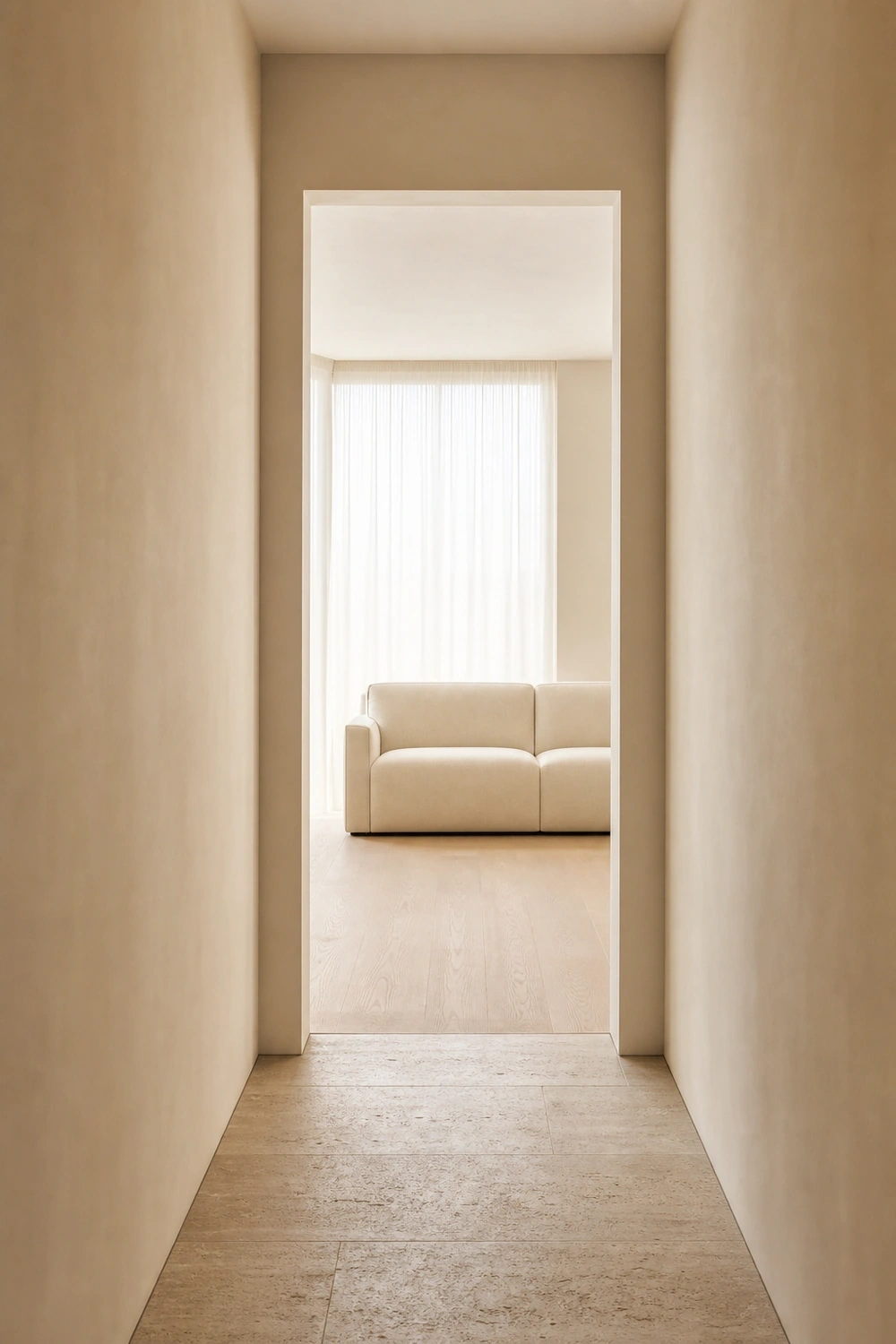
Warm minimalism can extend beyond the living room itself. The hallway concept uses a centered, one-point view to frame a cream sofa at the far end, with pale travertine beneath the passage and oak beginning beyond the doorway. The restrained palette makes the change in flooring legible without turning it into a decorative border. For adjoining spaces, repeat the wall color and keep door openings untrimmed or minimally trimmed. Material transitions should occur at a clear architectural threshold, allowing the shift in texture to guide movement naturally.
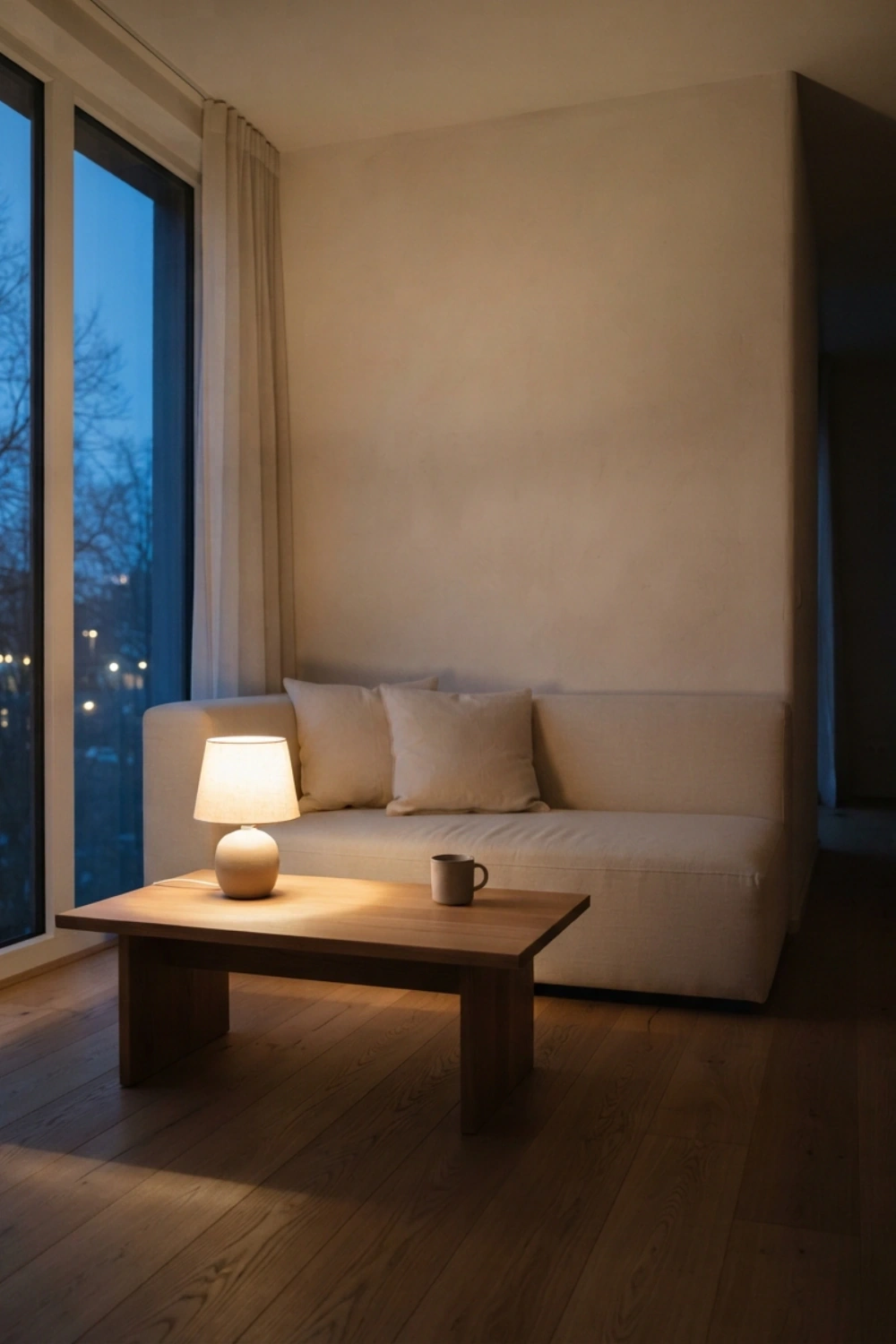
The final room shows how the palette behaves after daylight fades. Blue dusk outside the tall window contrasts with a small table lamp glowing on the low oak table. The cream sofa, loose cushions, and simple mug catch the lamp’s warm falloff, while the rest of the room remains in deep brown shadow. This is a more convincing evening strategy than filling the ceiling with bright downlights. Use one low source near the seating area, choose a warm bulb, and let some corners remain dark. The room will feel quieter, the wood will read richer, and the neutral upholstery will retain its softness instead of turning stark.
Together, these concepts show that a warm minimalist living room does not require a long shopping list. A controlled palette, two or three tactile materials, carefully scaled furniture, and light with a clear direction can do most of the work. Continue the same material study in our warm minimalist bedroom collection, or browse the full gallery → for more ways to combine oak, plaster, linen, wool, and warm neutral color in spaces that remain calm but never austere.